

Bonds Are Back: Why 5% Treasury Yields Create a Rare Opportunity for Investors
Clients have been asking a lot lately about interest rates and rightfully so. For the first time in about two decades, 10-year Treasury rates have sustained a move above 5%. On October 5, 2026, the yield on a 10-year Treasury bond touched 5.31%, compared to a year ago it was around 4.1%.
During the recent increase, the pain has been real. The US Aggregate Bond Index (the bonds' S&P 500) lost about 3.5% in the third quarter and is currently sitting around a loss of 2.48% so far this year. Seeing negative returns on bonds is never easy and can quickly bring back memories of 2022. However, we believe investors need to focus on the future as opposed to lamenting the past when it comes to thinking about the current opportunity in bonds.
Why Have Interest Rates Risen?
Before we explain why we think this is a great time to consider bonds, let’s take a step back and discuss how we got here in the first place. As a quick refresher, bond prices and interest rates work like a teeter-totter: when interest rates go up, bond prices go down and vice versa. The length of time until a bond matures will also affect how much the price moves up or down, a concept known as “duration.” A combination of strong economic growth, recent inflationary pressures due to rising energy prices, and an ever-expanding debt/deficit have all joined forces to push rates higher across both short and long rates. This has led to the tough bond year that we described earlier.
Why Now Is an Attractive Time for Bonds
First off, we aren’t necessarily saying that this is the “top” for rates. Most Fed officials have projected more rate hikes in the future, and the next meeting is on October 27, 2026. Meanwhile, if the situation in Iran continues without a resolution, energy prices are likely to stay elevated and continue to put pressure on inflation. It’s certainly feasible that rates can continue to rise from here. However, calling the top means less than taking advantage of the current yields as they continue to become more attractive. The chart below shows that starting bond yields have been a very good predictor of actual returns going forward.
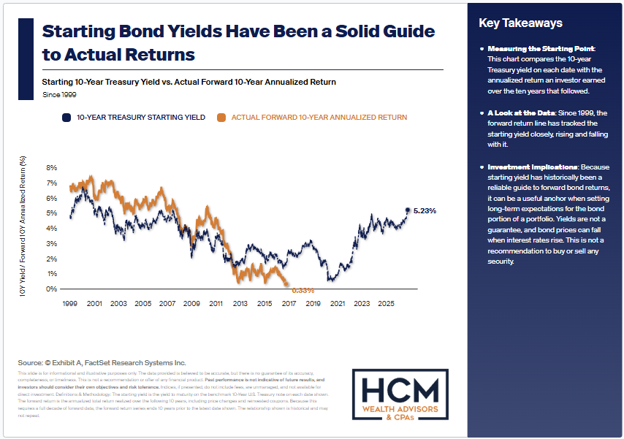
This is important to consider as we look at current yields and the total returns they are likely to generate going forward. With 10-year Treasury yields around 5.25% and investment grade corporates around 6%, investors can create meaningful income from the non-equity portion of their portfolio. For the highest tax bracket investors (37% bracket), intermediate-term, investment grade municipal bonds are offering tax-equivalent yields of close to 7%!
Not only are yields offering elevated starting points, but they are also competing with stocks on a relative basis. At roughly 19x forward earnings, the S&P 500’s earnings yield is about 5.3%, essentially the same as the 10-year. Treasuries and corporates offer that income with far less volatility.
Are Bonds Still a Good Hedge Against Stock Market Volatility?
Historically, bonds have also offered relative safety in times of significant equity volatility. Yes, 2022 proved that it doesn’t happen that way every time but looking back on history, 2022 remains a significant outlier. The chart below shows the maximum drawdown for both stocks and bonds going back to 1990.
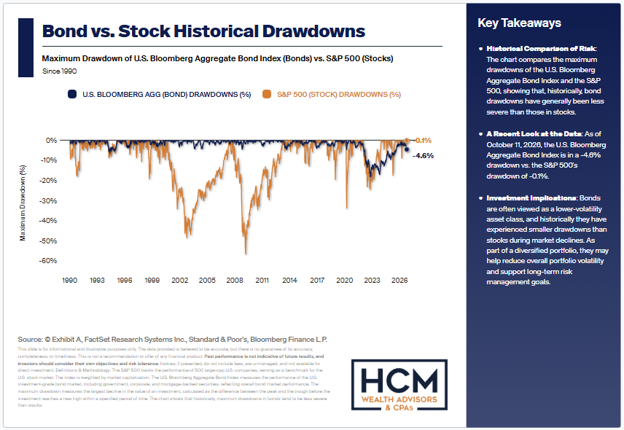
You will notice outside 2022, high-quality bonds were very effective in reducing overall portfolio volatility. Taking it back further, during the 26 down years for the stock market going back to 1929, the average return of the S&P 500 was -13.5%. In those same years, high-quality bonds averaged a gain of 4.3%, outperforming it by nearly 18%.
Watch Your Bias
Behavioral biases are very common in investing and are one of the biggest hurdles to overcome in order to generate above-average returns over the long run. One of the most common is recency bias, which happens when investors give greater importance to recent events and experiences rather than to older historical data. We have already touched on 2022, but it is the perfect example of recency bias in action. We still feel the emotional pain of that year and believe that it is now the new normal, almost expecting it to happen again rather than seeing it for what it was: a highly unlikely statistical outlier. And while statistical outliers don’t equal impossible events, they must be treated from an objective framework. Just like in the equity market, very large drawdowns are statistically rare, but they do happen and almost always offer investors ideal opportunities to capture above average forward returns.
Another more subtle version of recency bias is comparing the potential returns of bonds going forward to the above average run of equity returns we have seen over the past 5 years. Many investors are wondering aloud: Why would I buy bonds when I continue to get double digit equity returns year after year? A perfectly fair question and a statement that is backed by hard data as the return differential over the past 5 years between stocks and bonds has been quite large. But as many have heard the phrase, “past performance is no guarantee of future returns,” the chances that stock returns will eventually revert to their long-term averages, or possibly below that level, are higher than normal. It’s not necessarily a question of if, but when? We certainly don’t pretend to know that answer, but preparing for that possibility ahead of time is what makes average investors, good investors.
To summarize, we believe the rise in rates has presented investors with a very good opportunity in high-quality bonds. Even if rates do continue to climb, we have entered the range where future return potential looks better than it has in almost 20 years. In fact, going back all the way to 1793, we are currently experiencing the worst rolling 10-year annualized return period in high-quality bonds ever.
It’s also important to remember that not all bonds and bond products are created equal. Here are some things we would pay attention to when looking at certain opportunities:
- Stagger Your Entry: buy in tranches or use a ladder or defined-maturity fund so you know when the principal comes back. This can also help mitigate interest rate risk.
- Keep Quality High: while lower quality bonds may offer higher yields, we don’t believe investors are being sufficiently compensated for taking on the excess default/credit risk. Focus on investment grade products.
- Best Value is Intermediate Term: intermediate term bonds currently offer the best mix of income and potential total return for different rate scenarios.
If you have questions about your portfolio or would like to talk about your investment strategy further, please reach out to an HCM advisor at info@hcmwealthadvisors.com.